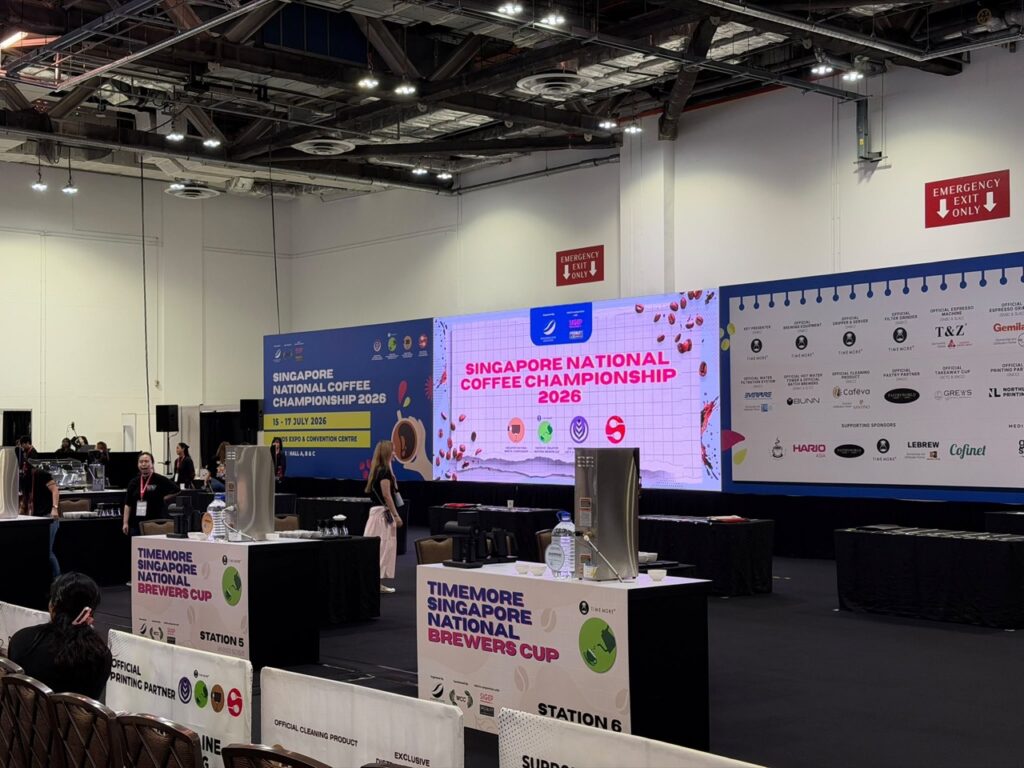
From 15 to 17 July we took part in SIGEP Asia, held at the Marina Bay Sands Expo & Convention Centre in Singapore. The event gathers foodservice professionals, buyers, importers, distributors and HoReCa operators from across the Asia-Pacific region — a part of the world where Italian coffee arrives with a strong reputation and very little context.
It was the second stop in our international programme this year, after Warsaw in June, and the two could hardly have been more different.
Meetings that open new markets
SIGEP Asia is compact by design, and built around scheduled professional meetings rather than footfall. We arrived with an agenda already partly filled through direct outreach, supplemented by the matchmaking platform, and the rest filled itself: our stand sat close to the tasting areas, so product conversations kept turning into conversations about working together.
That is the honest mechanics of a trade fair for a mid-sized roastery. You do not sign distribution agreements over a counter. You find out, in fifteen minutes, whether there is a fit worth exploring — and you leave with the names of the people worth calling in September.
Singapore, a crossroads for Asia-Pacific
The most striking thing was who walked in. Beyond operators based in Singapore, we met professionals from Malaysia, Vietnam, Indonesia, Thailand, Cambodia, China, Australia and New Zealand.
It confirmed what we had been told: Singapore functions as a meeting point between markets rather than a market in itself. For a company at our stage of international development, three days there gives access to conversations that would otherwise take a year of separate trips.
Italian coffee meets new tastes
Tastings told us more than any presentation could. This is an audience with different habits: Italian espresso sits alongside milk-based drinks, filter coffee, and a serious and growing interest in complex aromatic profiles.
Our blends were received well at both ends of that range — by buyers who want intensity and body, and by operators working in the premium segment who read a cup for its aromatic detail. What became clear is that quality alone does not travel. An operator assessing a new coffee is thinking about where it sits in their range, who they will sell it to, and what they can say about it. Sensory profile and blend positioning end up mattering as much as packaging and certifications in defining what is actually a commercial proposition.
A story that adds value to the product
The interest in our history caught us slightly off guard. Being a family business reaching its fourth generation, with family members actively involved in running the company and in its international work, turned out to be one of the things distributors asked most about.
It makes sense on reflection. A distributor has to sell our coffee to their own customers, and a roastery in Milan that has been in the same family since 1948 gives them something to say that a specification sheet does not.
From Singapore to the next stops
We came back with new relationships to develop and a better understanding of how our coffee is read in markets very unlike our own. SIGEP Asia closes the first phase of this year’s international programme; from September we resume, with an event in China in November.