Roasting is where green coffee becomes coffee. It is one of the very few stages that genuinely distinguishes one roaster from another, and it is almost always explained either in marketing language or in terms so technical that a buyer cannot act on them. It is worth setting out plainly.
What happens in the drum
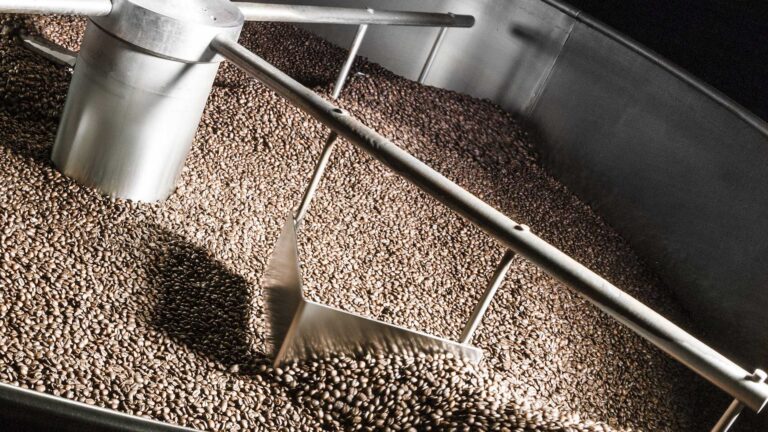
Green beans rotate in a heated drum and develop over time. Sugars caramelise, acids transform, hundreds of aromatic compounds form and some of them break down again. Water leaves the bean, its structure changes, and it eventually cracks — twice, at predictable points that roasters use as markers.
The variables are temperature and time, and the relationship between them across the whole curve is what defines the result. Two roasteries can reach the same colour by very different paths and produce very different coffee.
Slow versus fast
Faster industrial methods reach the target colour in a few minutes at high temperatures. Throughput is high, cost per kilo is low, and for a large part of the market that is exactly the right trade-off.
Slow roasting takes considerably longer at lower temperatures. The bean develops more evenly from the outside in, which reduces the risk of a scorched surface around an underdeveloped centre. The cup tends to have more body and less sharpness. The cost is hourly output: the same drum produces far less coffee in a day.
Why a person still supervises it
Much of the process is automated, and much of it should be — automation is what makes a profile repeatable across hundreds of batches, which is precisely what a professional customer needs.
But green coffee is an agricultural product. It varies by harvest, by origin, by lot, by how much moisture it has picked up in storage. Someone has to decide whether this batch, today, is behaving as expected and what to do if it is not. In our roastery that decision belongs to our roastmaster, batch by batch, and every lot is tasted before it ships.
What it means for you
Roasting method is not usually the first thing a buyer asks about, and it should probably be the third or fourth. It explains differences in the cup that are otherwise mysterious, and it tells you something about the kind of company you are dealing with.
If you are buying for a market that values body and a persistent crema — espresso-based service, milk drinks that need the coffee to come through — this is the method that produces it.
If you need very large volumes at the lowest possible cost per kilo, it is worth knowing that slow roasting is not built for that, and a supplier who tells you so is saving you both time. Knowing which of the two you need is more useful than any argument about which method is better.
Why blends still dominate professional service
Single origins have the attention, and rightly: they show what a particular place produces in a particular year. But a venue serving hundreds of cups a day needs a cup that does not change when that year ends.
A blend exists precisely to be reproducible. When one origin has a poor harvest, the composition is adjusted so the cup stays where the customer expects it. That is the whole point of blending for professional use, and it is why our five lines are built as blends rather than as a rotating selection.
How to check a claim
Ask how long a typical batch takes and at what drum size. Ask whether profiles are logged and repeatable. Ask who decides when a batch is finished.
Precise answers indicate a roastery that measures what it does. Vague answers indicate a phrase on a website.